Changes to our Local Government Infrastructure Plan
Toowoomba Regional Council is progressing an interim amendment to its Local Government Infrastructure Plan (LGIP).
The LGIP forms part of the Toowoomba Region’s planning scheme and guides the planning and delivery of trunk infrastructure such as transport, water supply, sewerage, stormwater, and parks – recognising that the way Council plans for and delivers infrastructure shapes where we live, how we live and the services we use every day.
The purpose of the amendment is to update the long-term planning, goals, schedule of works, and spatial data across key infrastructure networks. This amendment ensures Council remains complaint and responsive to population growth, development patterns, and infrastructure demand to align with Council’s priorities and extend the planning horizon of infrastructure networks to 2036.
Our LGIP ensures we:
- Understand community needs, expectations, and service levels to define the desired future state of infrastructure.
- Identify gaps between current infrastructure planning and future community aspirations.
- Set strategic goals for growth, settlement patterns, and efficient infrastructure service standards.
- Plan for population and employment growth by identifying infrastructure capacity, upgrades, and new assets.
- Align growth sequencing and infrastructure delivery with financial sustainability, asset management, and long‑term planning.
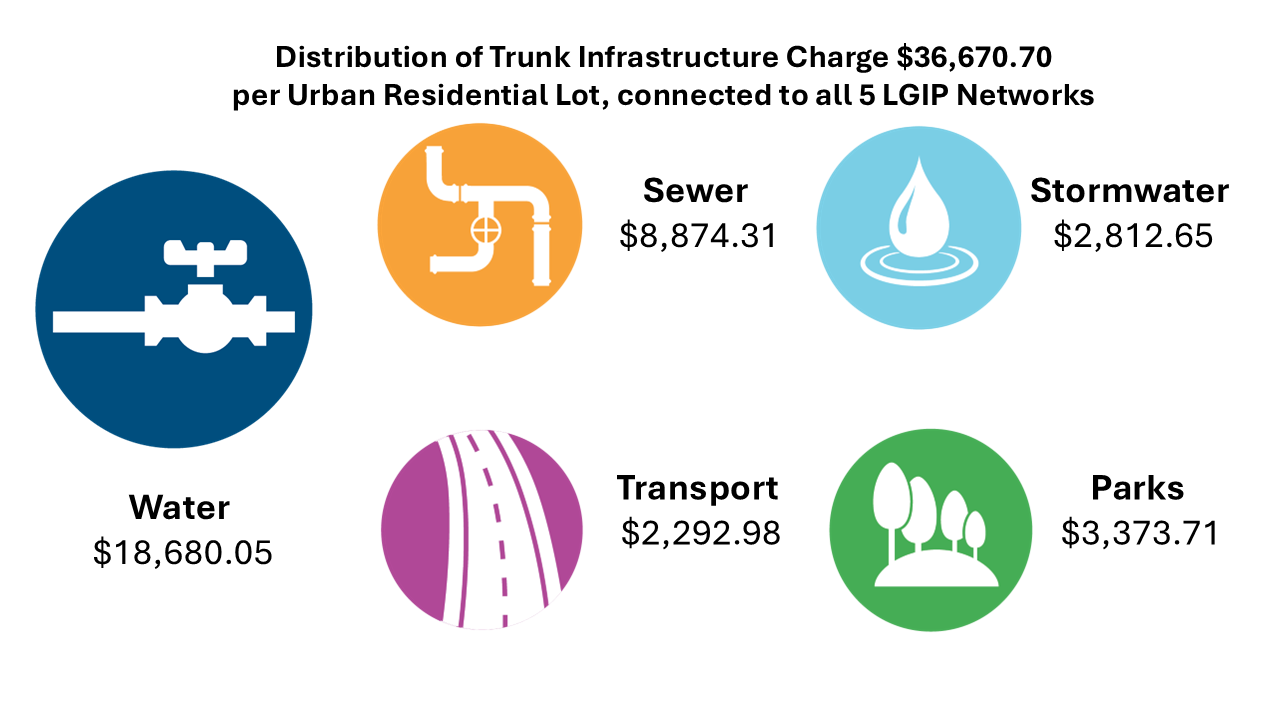
Trunk infrastructure (as identified in the LGIP) is funded through a mix of developer contributions and council funding. A method of funding includes infrastructure charges. For example, for each new lot created in a residential zone, a dwelling with 3 or more bedrooms in an urban charge area has an adopted charge of $36,670.70, as per our Infrastructure Charges Resolution No. 7. Infrastructure charges are distributed on a per‑lot basis as each new lot has the potential to generate demand for public infrastructure such as roads, water supply, sewerage and parks. Applying the charge per lot ensures that the cost of providing this infrastructure is equitably shared by all new dwellings and provides consistency and transparency for developers when planning and delivering subdivisions.
Below illustrates the distribution of a developer’s infrastructure charge per lot in a new subdivision.
The interim amendment focuses on:
- Refined demand projections for population, employment, development and infrastructure
- Updated network planning for current and future trunk infrastructure to support future capacity
- Update Schedule of Works (SOW) set out for trunk infrastructure upgrades and development
- Plans for trunk infrastructure (PFTI) updated to reflect SOW (excluding the Priority Infrastructure Area)
- Updated establishment of costs and financial sustainability planning for future trunk infrastructure
The Priority Infrastructure Area has not been altered in this interim amendment.
The proposed interim LGIP amendment changes are in alignment with the Ministers Guidelines and Rules under the Planning Act 2016 (Qld). This interim LGIP amendment forms part of the broader program of the new Planning Scheme project, which also includes the preparation of a new LGIP. Additional work is currently progressing to support Council’s new LGIP, including a PIA review, benchmarking of Council’s Desired Standards of Service (DSS), and refinements to network planning and cost estimates. The new LGIP will be developed in parallel with the new Planning Scheme.